

Hey there! As a supplier of PVC Pipe ACR Processing Aid, I've been in the thick of it when it comes to understanding what makes these aids perform well. There are several factors that play a crucial role in determining the performance of PVC Pipe ACR Processing Aid, and I'm gonna break them down for you.
Chemical Composition
The chemical makeup of the ACR processing aid is like the DNA of its performance. Different monomers are used in the synthesis of ACR, and the ratio in which they're combined can significantly affect how the aid works. For example, the amount of methyl methacrylate (MMA) in the polymer can influence the aid's ability to promote fusion in PVC pipes. A higher MMA content generally leads to better fusion, which means the PVC particles will melt and blend more evenly during the processing. This results in pipes with improved mechanical properties, like better impact resistance and tensile strength.
Also, the presence of other functional monomers can add specific features to the processing aid. Some monomers can enhance the aid's compatibility with PVC resin, ensuring that it disperses uniformly throughout the material. This uniform dispersion is key to achieving consistent performance across the entire length of the PVC pipe. If the aid doesn't disperse well, you might end up with weak spots in the pipe, which can lead to failures down the line.
Molecular Weight
Molecular weight is another biggie. It's kind of like the size of the building blocks in the polymer. A higher molecular weight ACR processing aid can provide better melt strength to the PVC. Think of it as giving the molten PVC more "body" so that it can hold its shape better during extrusion. This is especially important when making pipes with complex shapes or thin walls. With good melt strength, the pipe won't sag or deform while it's being formed.
On the flip side, a lower molecular weight aid can improve the flowability of the PVC melt. This is useful when you need to process the PVC at lower temperatures or when you're working with a high - speed extrusion process. However, if the molecular weight is too low, the aid might not be able to provide enough reinforcement to the PVC, and the pipe's mechanical properties could suffer.
Particle Size and Distribution
The particle size of the ACR processing aid and how evenly those particles are distributed matter a lot. Smaller particle sizes generally mean better dispersion in the PVC resin. When the particles are tiny, they can mix more easily with the PVC molecules, leading to a more homogeneous blend. This homogeneous blend translates into more consistent properties in the final PVC pipe.
A narrow particle size distribution is also important. If the particle sizes vary widely, some parts of the PVC might get too much of the processing aid, while other parts get too little. This uneven distribution can cause variations in the pipe's physical and mechanical properties, such as hardness and flexibility.
Processing Conditions
The way you process the PVC with the ACR processing aid can make or break its performance. Temperature is a major factor. If the processing temperature is too low, the PVC might not melt properly, and the ACR aid won't be able to do its job of promoting fusion. On the other hand, if the temperature is too high, the PVC can degrade, and the processing aid might lose its effectiveness.
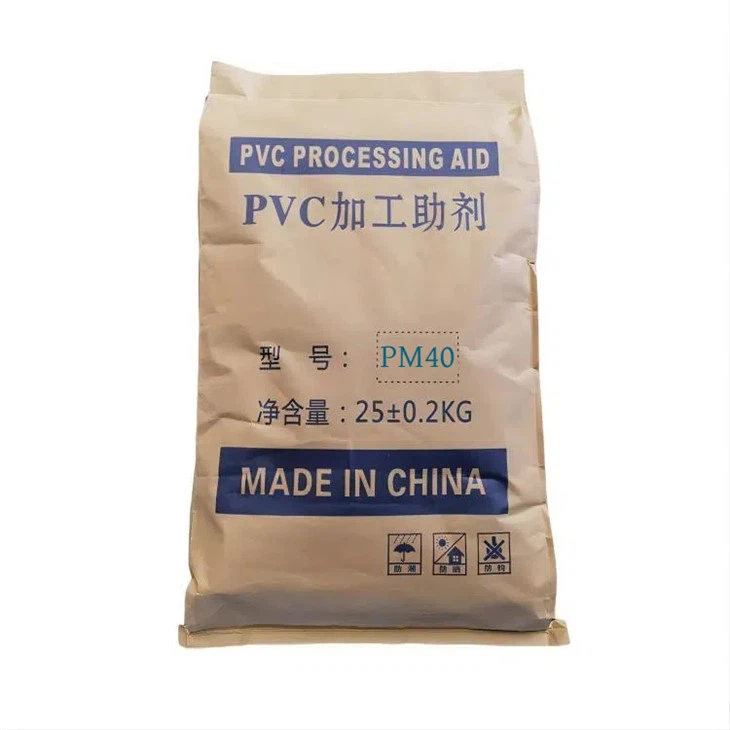
The shear rate during extrusion is also critical. A higher shear rate can help break up the ACR particles and improve their dispersion in the PVC. But if the shear rate is too high, it can cause the PVC to overheat and degrade. So, finding the right balance of temperature and shear rate is essential for getting the best performance out of the ACR processing aid.
PVC Resin Quality
The quality of the PVC resin you're using in combination with the ACR processing aid has a huge impact. Different PVC resins have different molecular structures and properties. For example, some resins might have a higher degree of polymerization, which can affect how the ACR aid interacts with them. A high - quality PVC resin with a consistent molecular structure will generally work better with the processing aid, resulting in more predictable and better - performing PVC pipes.
Impurities in the PVC resin can also interfere with the performance of the ACR processing aid. These impurities can react with the aid or the PVC itself, leading to issues like discoloration, reduced mechanical properties, or poor processing characteristics. So, it's important to use high - purity PVC resin to get the most out of the ACR processing aid.
Compatibility with Other Additives
In most cases, PVC pipes aren't just made with PVC resin and ACR processing aid. There are usually other additives involved, like stabilizers, lubricants, and fillers. The compatibility of the ACR processing aid with these other additives is crucial.
If the ACR aid isn't compatible with the stabilizer, it could lead to chemical reactions that degrade the PVC or the aid itself. For example, some stabilizers might react with the functional groups in the ACR aid, changing its chemical structure and reducing its effectiveness. Similarly, if the lubricant isn't compatible with the ACR aid, it can cause separation or uneven distribution of the components in the PVC melt.
When it comes to fillers, the ACR processing aid needs to be able to interact with them in a way that enhances the overall performance of the PVC pipe. Some fillers can improve the stiffness and strength of the pipe, but they can also make the processing more difficult. A good ACR aid can help overcome these challenges by improving the dispersion of the fillers and reducing the viscosity of the PVC melt.
Storage and Handling
How you store and handle the ACR processing aid can also affect its performance. If the aid is stored in a humid environment, it can absorb moisture. Moisture in the aid can cause problems during processing, such as foaming or reduced mechanical properties in the final PVC pipe. So, it's important to store the aid in a dry place, preferably in sealed containers.
Also, proper handling during transportation and mixing is essential. Rough handling can cause the particles of the ACR aid to agglomerate, which can lead to poor dispersion in the PVC resin. When mixing the aid with the PVC resin, it's important to follow the recommended procedures to ensure a uniform blend.
Now, if you're in the market for high - quality PVC Pipe ACR Processing Aid, you might also be interested in some related products. Check out our PVC Surface Hardening Agent, PVC Foaming Profile Acrylic Acid Additives ACR, and PVC Floor Special Tempering Agent. These products are designed to work in harmony with our ACR processing aids to enhance the performance of your PVC products.
If you have any questions about our PVC Pipe ACR Processing Aid or want to discuss your specific requirements, feel free to reach out. We're here to help you get the best - performing PVC pipes for your needs. Whether you're a small - scale manufacturer or a large - scale industrial operation, we've got the expertise and the products to support you.
References
- "Polyvinyl Chloride (PVC) Handbook" by William V. Titow.
- "Plastics Additives: An A - Z Reference" by Geoffrey Pritchard.
- Various industry research papers on PVC processing and ACR processing aids.